About
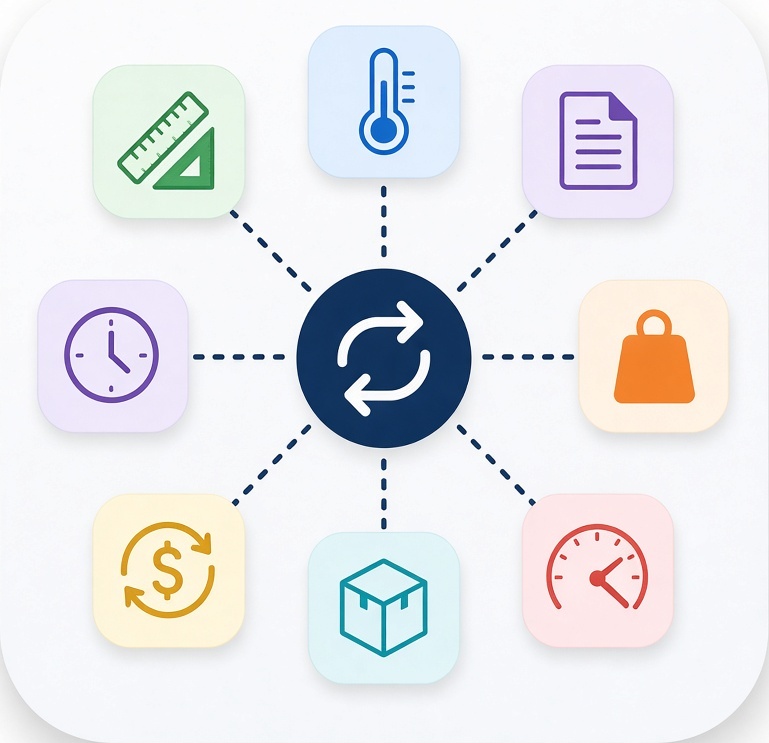
ConverterStack is a simple, fast collection of converters. The goal is to cover as many things you might need to convert as possible, and make them easily accessible. Every conversion is ran completely in the browser, file conversions included.
No sign-ups, no clutter, no fuzz. Pick your units, type a value, and get the answer instantly.
ConverterStack is open source under the MIT licence. The code is available on GitHub — bug reports, feature ideas and pull requests are welcome.
How it works
Most conversions on this site happen entirely on your own device — the moment you type a value or drop a file, the computation runs in your browser and nothing is sent anywhere. The one exception is exchange rates, which need a real-world number to start from; that section below explains what does and does not leave your device.
Unit converter
Every unit inside a category (length, mass, volume, and so on) is defined by a fixed conversion factor relative to a base unit. Converting between two units is a single multiplication — or, for temperature, a short formula with an offset and a factor — computed in plain JavaScript in your browser the instant you type. There is no lookup table to fetch and no network request involved.
Time zone converter
Each time zone here is modelled as a fixed offset from UTC. This intentionally ignores daylight saving time changes, so the offset for a given zone never shifts depending on the date — it stays a simple, predictable calculator. Converting a time is just adding the difference between the two offsets to the time you entered, done locally with no server involved.
Exchange rate converter
Currency values cannot be computed from a fixed formula — they depend on real-world markets, so a starting number has to come from somewhere. Exchange rates are fetched once a day from a currency data provider and published as part of the site, so the rate you see is at most a day old. Once those rates are loaded, converting between any two currencies is ordinary multiplication and division, done in your browser.
File converter
File conversions run entirely in your browser — your files are read with the File API and never uploaded to a server. Images are converted with your browser's own canvas and image codecs; audio and video use the WebCodecs API built into your browser; PDFs are rendered and built with small open-source libraries that run alongside the rest of the page. Some formats or combinations may not be supported on every browser or device — when that happens, the converter says so and suggests alternatives that are. See the third-party licences page for the exact libraries and versions used for each format.